
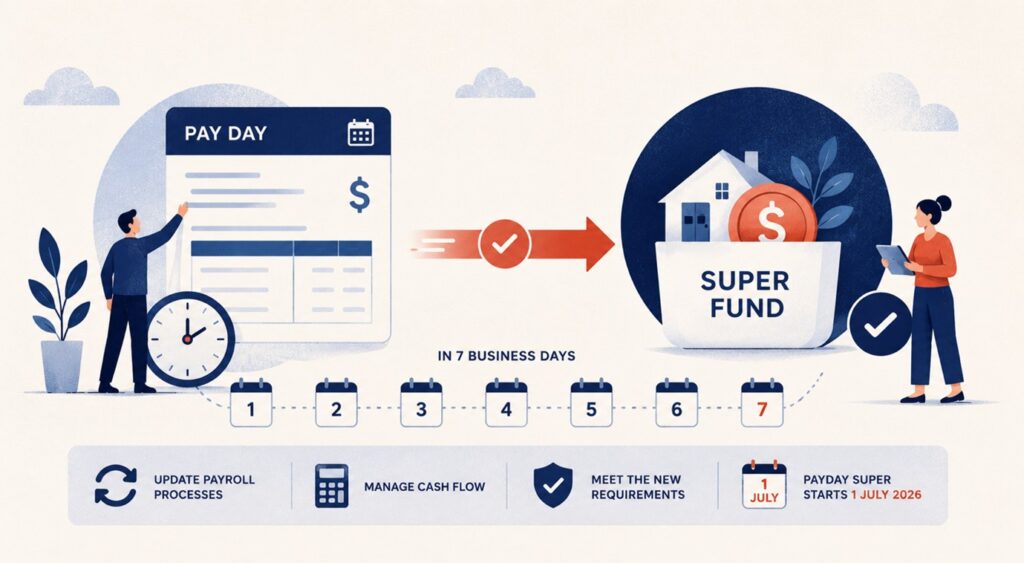
From 1 July 2026, the way Australian employers pay superannuation changes permanently. Instead of quarterly payments, super must be paid alongside every single pay run and reach the employee’s fund within 7 business days of payday.
This is the most significant change to superannuation in decades. The total amount you owe doesn’t change, but the timing, the systems, and the penalties for getting it wrong all do.
What’s Actually Changing
Under the current rules, employers have until 28 days after the end of each quarter to pay super. That quarterly buffer, sometimes two to three months of super sitting in your account, disappears entirely from 1 July.
If you pay staff fortnightly, you’ll make 26 super payments per year instead of four. Weekly payroll means 52 payments. Each one must arrive in the employee’s fund within 7 business days of payday.
There’s also a change to how super is calculated. The earnings base shifts from ordinary time earnings (OTE) to a new concept called qualifying earnings (QE), which is slightly broader and includes some additional payment types. This could affect calculations for employees with irregular pay structures or bonuses.
The Cashflow Reality
For many small businesses, this is the practical crunch point. Research from Prospa and YouGov found that 41% of SMEs lack a clear understanding of the changes, and of those who do understand them, 19% say they’re not prepared.
Employment Hero’s modelling across more than 300,000 businesses put the average working capital shift at $124,000, though the actual impact depends heavily on team size, wage levels, and pay cycle frequency.
If your current cashflow forecasts don’t reflect per-payday super payments, your picture of working capital from July onward is likely wrong. Talk to us about modelling the specific impact for your business.
The Clearing House Is Closing
If you use the ATO’s Small Business Superannuation Clearing House (SBSCH) to process super payments, you need to act now, it closes permanently on 1 July 2026. It stopped accepting new registrations in October 2025 and was never designed to handle the speed and volume that Payday Super demands.
You’ll need to transition to an alternative payroll solution or clearing house that can process super at each pay cycle. Several commercial providers offer this, and some super funds (including AustralianSuper) offer a free clearing house for employers.
The Penalties Are Steeper
Under the current system, the Superannuation Guarantee Charge (SGC) is assessed per quarter. Under Payday Super, it’s assessed per payday. Miss the 7-business-day window on any pay run and you face the unpaid super amount, plus interest, plus an administrative uplift of up to 60%, and it’s not tax deductible.
One timing trap worth knowing: even if you initiate the payment on time, bank processing and clearing house delays can push the contribution past the 7-day cut-off. The ATO recommends paying super on the same day as wages to build in a buffer.
For company directors, the stakes are higher still. The ATO will now receive super data per payday, meaning shortfalls are identified faster and Director Penalty Notices can follow sooner.
The 1 July deadline is firm. Businesses that prepare now will transition smoothly; those that don’t face both cashflow surprises and penalties that are far more punishing than under the current system.
This article is general in nature. Please contact us to discuss your specific circumstances.