
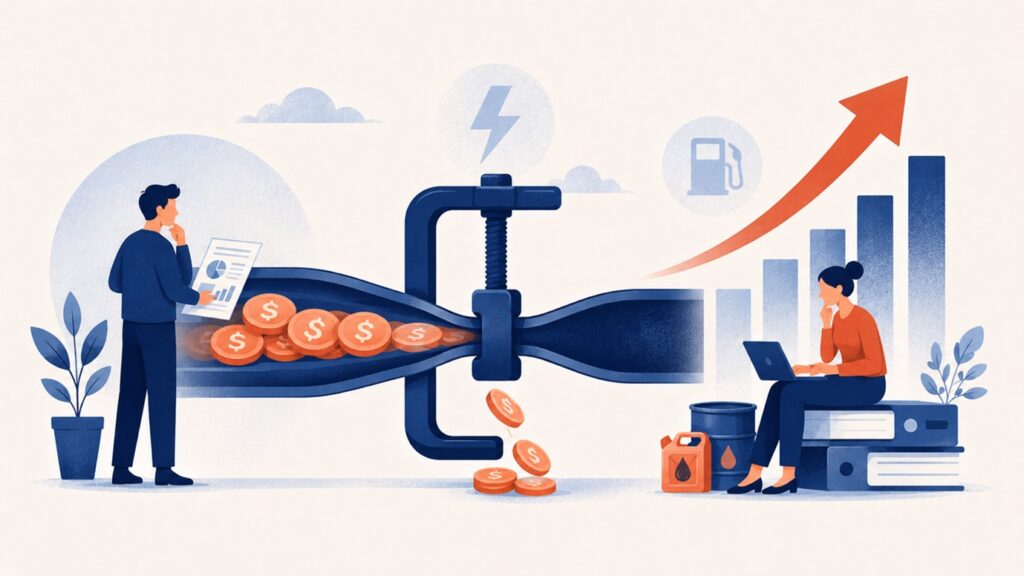
The RBA has raised the cash rate three times in 2026 (from 3.85% to 4.35%) driven largely by inflation flowing from the Middle East conflict and its impact on fuel and energy prices. Westpac economists are forecasting a fourth hike at the 16 June meeting, potentially pushing the rate to 4.60%, with a projected peak of 4.85% by August.
For businesses, this isn’t just a headline number. It flows directly into borrowing costs, consumer spending, and the pace at which customers pay.
The Real-World Impact
Every 0.25% rate rise adds roughly $2,500 per year in interest on a $1 million variable-rate loan. For businesses carrying debt across property, lines of credit, or equipment finance, three consecutive hikes add up fast.
Beyond the direct cost of debt, higher rates are suppressing spending on both sides of the ledger. Customers are slower to commit. Discretionary purchases are being deferred. And with second-round effects from fuel costs flowing through into broader input prices, many businesses are seeing costs rise at the same time as revenue growth slows.
The insolvency numbers reflect the strain. Business-related personal insolvencies accounted for nearly 79% of new debt in recent AFSA data, a concentrated burden falling on small and sole-trader operators. Construction and hospitality remain the hardest-hit sectors, but the pressure is spreading.
Two Things Making It Harder
ATO debt is now more expensive. Many businesses are still carrying legacy tax debt. From 1 July 2025, the General Interest Charge on ATO debt, currently around 11% per annum, is no longer tax deductible. What was once a manageable cost has become one of the most expensive forms of debt a business can hold.
Payday Super changes the cashflow equation. From 1 July 2026, super must be paid with every pay run rather than quarterly. For businesses already running tight, the loss of that quarterly float requires a rethink of working capital planning before the new financial year begins.
If your cashflow forecasts haven’t been updated to reflect the current rate environment and these two structural changes, now is the time to revisit them.
This article is general in nature. Please contact us to discuss your specific circumstances.